






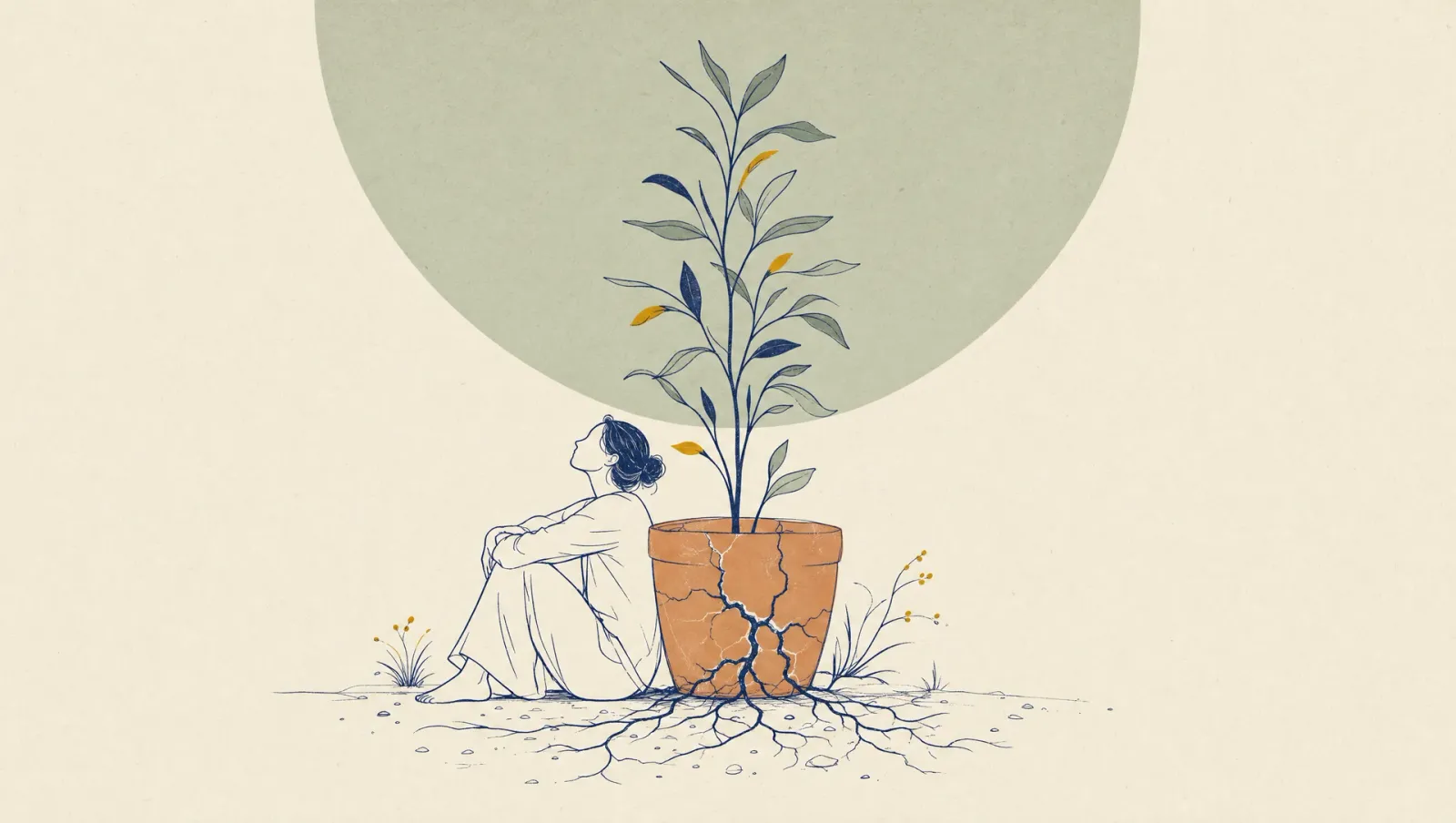
You have been praying for the same thing since a Tuesday in 2021. Maybe longer. Maybe you no longer remember exactly when it started, only that you noticed at some point this year that you were still asking and nothing had moved.
Most writing about waiting on God assumes the wait is nearly over. This is for the other kind of wait, the one that has gone on long enough that you have stopped mentioning it, because you are tired of explaining why you are still here.
The Psalms are full of people who waited until they started to wonder whether God could hear them, and the prophets describe waits that outlived the people who began them. The sections below are sorted by what the waiting is doing to you. A long wait often turns into grief somewhere along the way, quietly, and walking it through with someone is usually how people notice.

A wait long enough to blur the request
You started out clear-eyed about this. You knew what you were asking for and you could have said it in one sentence. Somewhere along the way the request blurred. You still pray about it, though you would struggle now to say exactly what you are praying for, and the hope has gone vague.
Psalm 27:14
"Wait for the Lord; be strong and take heart and wait for the Lord." -- Psalm 27:14
It is a small detail, but the verse asks you to wait twice, and the strengthening sits in the middle. The psalmist makes no promise that the wait will end. He is teaching you how to live inside it, which in some seasons is the more useful thing. Be strong while waiting, take heart while waiting, and notice that both instructions assume the waiting continues. The strengthening happens in the time before the answer, which makes it something available tonight rather than something held back until the situation resolves.
Psalm 130:5-6 captures this in language that is hard to forget once you have heard it: "I wait for the Lord, my whole being waits, and in his word I put my hope. I wait for the Lord more than watchmen wait for the morning, more than watchmen wait for the morning." The watchman waiting for sunrise is the writer's image for waiting that involves every part of you. You are not casually expecting something to happen. You are looking toward the horizon with your whole life because you know the morning has to come, even though you cannot make it come.
Lamentations 3:25-26 was written from inside the rubble: "The Lord is good to those whose hope is in him, to the one who seeks him; it is good to wait quietly for the salvation of the Lord." Quiet waiting is what the prophet learned in the place where loud waiting did not save anyone.
Henri Nouwen wrote an essay in 1987 called A Spirituality of Waiting that draws a line most people miss. Passive waiting is waiting for something to happen to you, and it corrodes. Active waiting is the conviction that something has already been planted and is under way where you are standing, which changes what you do with the time without changing how long the time is. He is saying the wait is not empty. He is not saying it is short. The quiet that comes after exhaustion can look like giving up from outside. It is closer to trust.
The grief hidden inside a long wait
At some point you work out that the waiting has cost you something on its own account, separately from whatever you were waiting for. You did not plan for this season, and you certainly did not budget for this many years of unanswered prayer. The thing you were waiting for would have happened during a part of your life that has now closed behind you, and those years are not returnable. So the wait is no longer only the wait. It has become the grief of what the waiting itself quietly took while you were busy being faithful inside it.
Proverbs 13:12
"Hope deferred makes the heart sick, but a longing fulfilled is a tree of life." -- Proverbs 13:12
This is one of the most quietly devastating verses in scripture. The Bible names what other people sometimes try to talk you out of. Yes, the long wait does something to your heart. Yes, hope that goes unanswered for years can make you sick in a way that is difficult to explain to people who have never been in a wait like yours. The verse tells you the truth and trusts you to carry it.
Romans 8:24-25 sits alongside this verse with a different angle: "Hope that is seen is no hope at all. Who hopes for what they already have? But if we hope for what we do not yet have, we wait for it patiently." Paul renames the waiting as the active shape of Christian hope. Hope is what you do when you cannot see yet. The not-seeing is what hope looks like by definition.
There is a psalm where the writer turns from his attackers and starts addressing himself, which is what you do when you are wearing thin: "Yes, my soul, find rest in God; my hope comes from him. Truly he is my rock and my salvation; he is my fortress, I will not be shaken." When you have been waiting long enough, you start to need to tell yourself who God is, because the silence makes you forget. The verse models the kind of self-talk that gets you through a long season - not denial of the difficulty, but the stubborn rehearsal of what is still true.

Watching other people move past you
A long wait puts you out of step with everyone around you. The friend who got married after you started praying for a spouse. The sister whose chronic illness ended in remission while yours kept going. The coworker whose career moved while yours sat still. The wait is hard enough on its own. It is harder when the people who began where you began have arrived somewhere while you are still standing where you were.
2 Peter 3:8-9
"But do not forget this one thing, dear friends: With the Lord a day is like a thousand years, and a thousand years are like a day. The Lord is not slow in keeping his promise, as some understand slowness. Instead he is patient with you, not wanting anyone to perish, but everyone to come to repentance." -- 2 Peter 3:8-9
Peter writes this to people who were beginning to wonder whether Jesus was coming back, because the first generation of believers was dying and the wait kept going. He does not minimize how the wait feels to them, and he does not tell them they were wrong to expect something sooner. What he refuses is the conclusion they were drawing from it, which was that a God who has not arrived yet must not be coming.
Be careful how far you carry this one. Peter is answering a question about the second coming, and the reason he gives for that delay is a reason about the world, not about your situation. It does not explain why your particular prayer has gone unanswered since 2021. What it does say is that slowness and indifference are different things, and that the first is not evidence of the second.
Habakkuk, who spends most of his book arguing, gets this back in 2:3: "For the revelation awaits an appointed time; it speaks of the end and will not prove false. Though it linger, wait for it; it will certainly come and will not delay." The line worth sitting with is "though it linger, wait for it." God acknowledges that what he has spoken does linger sometimes. He concedes the lingering and asks you to wait for it anyway, on the strength of who is speaking.
David takes the comparison problem head on: "Be still before the Lord and wait patiently for him; do not fret when people succeed in their ways, when they carry out their wicked schemes... For those who are evil will be destroyed, but those who hope in the Lord will inherit the land." The temptation when other people seem to be moving past you is to start hating them or to start hating yourself. The psalm names the temptation and asks for stillness in its place.
The temptation to force the answer
Every long wait reaches the moment where the option of forcing the answer starts to look reasonable. Abraham reached this point with Hagar. Saul reached it with the unauthorized sacrifice at Gilgal. The disciples reached it at every point when they tried to talk Jesus out of going to Jerusalem. You would rather have the wrong answer now than the right one later, and so would almost anyone who has waited this long, and a long wait will surface that something in you whether you are watching for it or not.
Psalm 40:1-2
"I waited patiently for the Lord; he turned to me and heard my cry. He lifted me out of the slimy pit, out of the mud and mire; he set my feet on a rock and gave me a firm place to stand." -- Psalm 40:1-2
Read the verbs and notice who is doing the work. David waits. After that every action belongs to God, who turns, hears, lifts him out, sets his feet on a rock and gives him a firm place to stand. The psalm does not say the waiting built the rock or that the pit was good for him. It says he waited, and then God moved. That is a smaller claim than the one usually made from this verse, and it is the one the text will actually carry.
James 5:7-8 picks up the same theme with an agricultural image: "Be patient, then, brothers and sisters, until the Lord's coming. See how the farmer waits for the land to yield its valuable crop, patiently waiting for the autumn and spring rains. You too, be patient and stand firm, because the Lord's coming is near." The farmer is the model because the farmer cannot make the rain come. He can till and plant and tend, but the actual yielding belongs to God. The wait teaches the farmer who the wait belongs to. The wait teaches you the same thing if you let it.
Then there is the verse you have read so often the words may have gone flat. It still works "But those who hope in the Lord will renew their strength. They will soar on wings like eagles; they will run and not grow weary, they will walk and not be faint." Notice that the verse does not end with soaring; it ends with walking, and the order descends. The eagle imagery is the headline, but the walking is the actual promise, and it is the one that applies to most Tuesdays. Strength for the part of the wait that involves putting one foot in front of the other when the soaring is nowhere in sight.
A name for the season you are in
Walter Brueggemann sorted the psalms into three groups in The Message of the Psalms: psalms of orientation, written when life is ordered and God's world makes sense; psalms of disorientation, written when it does not; and psalms of new orientation, written by people who came out somewhere they did not expect. His chapter on the disorientation psalms is the longest in the book, deliberately, because he thought the church had quietly stopped using a third of its own hymnbook.
You are in the middle group, which is a category the Bible has words for, and roughly a third of the Psalter was written from inside it by people who did not know yet whether they were headed for a new orientation or more of this.
Wondering whether God is still working
The hardest version of waiting is the slow erosion of confidence that God is paying attention. You start to wonder if the prayer is even being heard. You start to wonder if the thing you thought God said was something you made up. You wonder, sometimes, if you have been faithful about a thing God never promised.
Isaiah 49:14-16
"But Zion said, 'The Lord has forsaken me, the Lord has forgotten me.' Can a mother forget the baby at her breast and have no compassion on the child she has borne? Though she may forget, I will not forget you! See, I have engraved you on the palms of my hands." -- Isaiah 49:14-16
Elijah gets no rebuke here, which is the part worth noticing, and it is given specifically to people who have decided that God has forgotten them. God lets the complaint stand and answers it with one of the most intimate images he ever uses about himself. The waiting may make you wonder if you have been forgotten. God answers that wondering before you have finished asking it.
David opens Psalm 13 with a prayer nobody would print on a mug: "How long, Lord? Will you forget me forever?" He does not pretend the wait is fine. He prays the question and asks God to answer it. By the end of the psalm, David is not in a different season - the wait is still happening - but he has remembered the unfailing love of the Lord and let that remembering hold him until the answer comes. The psalm is permission to pray the hard question, and a model of where the praying eventually leads.
A few verses on from the passage above: "Because of the Lord's great love we are not consumed, for his compassions never fail. They are new every morning; great is your faithfulness. I say to myself, 'The Lord is my portion; therefore I will wait for him.'" The city is still rubble when he writes it. Nothing in his circumstances has turned, and what he reaches for is not an improvement but a fact about God that was true yesterday and is true again this morning. That is what a long wait sometimes asks of you. Not feelings of confidence. The daily decision to rehearse what you already know is true.
What are the other bible verses about waiting on God?
The verses people send you when they have run out of things to say, plus a few they never think of.
Psalm 130:5 - "I wait for the Lord, my whole being waits, and in his word I put my hope." Waiting described as something the whole person does, not a posture you adopt.
Psalm 37:7 - "Be still before the Lord and wait patiently for him; do not fret when people succeed in their ways." The instruction that follows the waiting is about other people's timelines, not your own.
Romans 12:12 - "Be joyful in hope, patient in affliction, faithful in prayer." Paul puts patience between hope and prayer. That is where it lives.
Galatians 6:9 - "Let us not become weary in doing good, for at the proper time we will reap a harvest if we do not give up." At the proper time, and the timing is explicitly not yours to set.
Micah 7:7 - "But as for me, I watch in hope for the Lord, I wait for God my Savior; my God will hear me." A prophet waiting inside a collapsing society.
Psalm 121:1-2 - "I lift up my eyes to the mountains - where does my help come from? My help comes from the Lord, the Maker of heaven and earth." A traveler's psalm, for people already on the road.
Isaiah 41:10 - "So do not fear, for I am with you; do not be dismayed, for I am your God." Said to people in exile, waiting with no announced end.
Hebrews 13:5 - "Never will I leave you; never will I forsake you." The promise underneath the waiting.
Romans 8:38-39 - "Neither death nor life... nor anything else in all creation, will be able to separate us from the love of God that is in Christ Jesus our Lord." The list is exhaustive on purpose.
Psalm 34:18 - "The Lord is close to the brokenhearted and saves those who are crushed in spirit." For the stretch where the waiting has done damage.
Psalm 27:14 - "Wait for the Lord; be strong and take heart and wait for the Lord." The instruction to wait appears twice, and the strengthening sits between them.
Habakkuk 2:3 - "For the revelation awaits an appointed time; it speaks of the end and will not prove false. Though it linger, wait for it; it will certainly come and will not delay." Linger and not delay sit in the same sentence on purpose.
Lamentations 3:25-26 - "The Lord is good to those whose hope is in him, to the one who seeks him; it is good to wait quietly for the salvation of the Lord." Written from inside the rubble of a destroyed city.
Isaiah 30:18 - "Yet the Lord longs to be gracious to you; therefore he will rise up to show you compassion... Blessed are all who wait for him!" The waiting is mutual in this verse. That is an unusual claim.
Psalm 40:1 - "I waited patiently for the Lord; he turned to me and heard my cry." David never says he waited well, only that he waited.
James 5:7-8 - "See how the farmer waits for the land to yield its valuable crop, patiently waiting for the autumn and spring rains. You too, be patient and stand firm." Farming is the metaphor because farmers cannot hurry anything.
The hardest part of a long wait is that it stops being a topic. People asked for the first year and then stopped, not unkindly, and now there is nowhere to put it. What helps is somebody who will ask again in month forty and not need you to have made progress since last time. If the waiting has turned into its own grief, or into something that keeps you up, a pastor or biblical counselor can sit in it with you. Get matched and stop waiting by yourself.